Top 10 Best Cement Factories in Iraq 2026 | Verified & Audited
The Iraqi cement sector in 2026 operates within a high-stakes environment characterized by rapid infrastructure expansion and the persistent threat of unregulated clinker imports. Forensic analysis reveals that while national capacity has reached approximately 49.46 million metric tons, local producers face significant operational hurdles including fluctuating energy costs and the necessity for stringent compliance with the Iraqi Central Organization for Standardization and Quality Control. Maintaining structural integrity in governorates like Baghdad, Basra, and Erbil requires a transition from traditional kilns to automated dry-process systems. This audit evaluates the resilience of manufacturers against market volatility and technical degradation. The following selection represents the definitive industry leaders, verified under the rigorous IRAP National Audit Protocol.
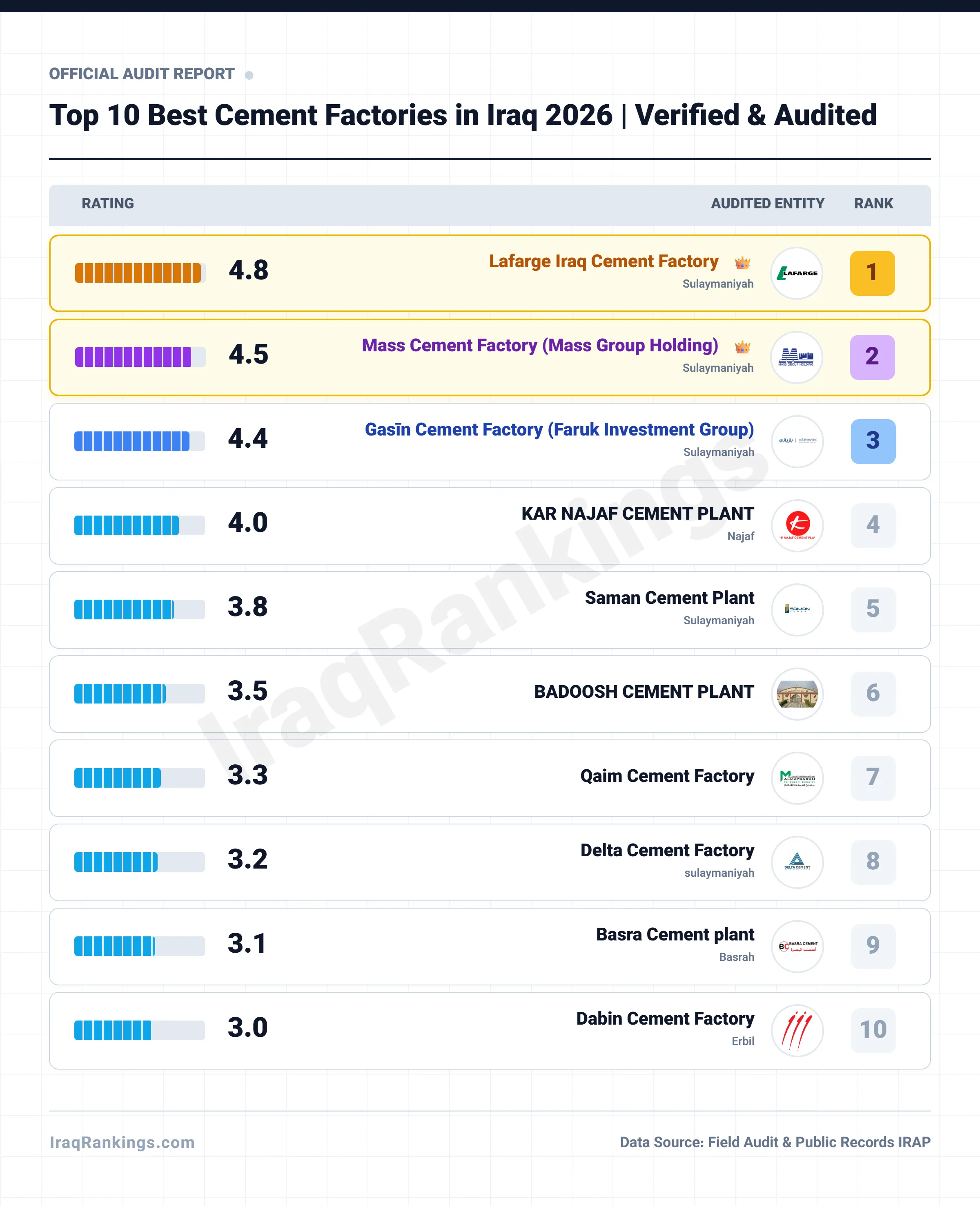
Summary of rankings in this infographic
- Rank: 1 - entity: Lafarge Iraq - Score: 4.8
- Rank: 2 - entity: Mass Cement Factory (Mass Group Holding) - Score: 4.5
- Rank: 3 - entity: Gasin & Tasluja Cement - Score: 4.4
- Rank: 4 - entity: Kar Najaf Cement Plant - Score: 4.0
- Rank: 5 - entity: Saman Cement Plant - Score: 3.8
- Rank: 6 - entity: BADOOSH CEMENT PLANT - Score: 3.5
- Rank: 7 - entity: Qaim Cement Factory - Score: 3.3
- Rank: 8 - entity: Delta Cement Factory - Score: 3.2
- Rank: 9 - entity: Basra Cement plant - Score: 3.1
- Rank: 10 - entity: Dabin Group - Score: 3.0
The Iraqi cement sector in 2026 operates within a high-stakes environment characterized by rapid infrastructure expansion and the persistent threat of unregulated clinker imports. Forensic analysis reveals that while national capacity has reached approximately 49.46 million metric tons, local producers face significant operational hurdles including fluctuating energy costs and the necessity for stringent compliance with the Iraqi Central Organization for Standardization and Quality Control. Maintaining structural integrity in governorates like Baghdad, Basra, and Erbil requires a transition from traditional kilns to automated dry-process systems. This audit evaluates the resilience of manufacturers against market volatility and technical degradation. The following selection represents the definitive industry leaders, verified under the rigorous IRAP National Audit Protocol.
Data Source: Official Audit Registry IRAP

Lafarge Iraq
Lafarge Iraq, a Holcim subsidiary, demonstrates high operational maturity. Verified capacity exceeds 10 million tons annually across Bazian, Tasluja, and Karbala. Audit confirms robust HSE frameworks and international governance standards. Financial transparency is supported by IFC-related disclosures. Primary risks involve high cost structures and exposure to regional infrastructure budget fluctuations.
Validated Capabilities
- Strategic multi-governorate presence (Sulaymaniyah and Karbala)
- Adherence to international Holcim Group governance standards
- Advanced HSE (Health, Safety, Environment) compliance protocols
Compliance Gaps
- Premium pricing structure relative to local competitors
- Operational sensitivity to energy supply disruptions
- Regulatory complexity in cross-governorate logistics
Mass Cement Factory (Mass Group Holding)
Mass Cement (Bazyan) operates as a Tier-1 industrial asset under Mass Group Holding. Verified capacity of 6 million tons annually across three lines. High compliance with Iraqi Standard No. 5 (2019). Significant capital investment of $10B group-wide ensures advanced dry-process technology and robust environmental filtration systems. Market leader in Sulaymaniyah and federal Iraq.
Validated Capabilities
- Verified annual capacity of 6 million tons
- Adherence to Iraqi Standard No. 5 (2019) specifications
- Advanced bag filter technology for environmental mitigation
Compliance Gaps
- High cost structure relative to regional imports
- Regulatory exposure to fluctuating energy tariffs
- Operational dependency on heavy industrial power stability
Gasin & Tasluja Cement
Subsidiary of Faruk Investment Group. Operational since 2016. Capacity: 5,300 tons/day via dry process. Located in Sulaimani. High compliance with international standards (OPC, SRC, CEM II). Integrated into diversified industrial ecosystem. Verified infrastructure by Sinoma. Strong regional market penetration and regulatory alignment.
Validated Capabilities
- High daily output capacity of 5,300 tons
- Diversified product portfolio (OPC, SRC, CEM II)
- Strategic proximity to Sulaimani industrial hubs
Compliance Gaps
- High operational cost structure in energy-intensive dry processes
- Exposure to regional logistics and supply chain volatility
- Regulatory gaps in cross-governorate trade frameworks
Kar Najaf Cement Plant
Operational since 2016 under Investment License 168. Verified capacity of 2.1 million tons annually. Facility utilizes FLSmidth technology. High compliance with ISO 9001 and ISO 17025 standards. Strategic location in Najaf Governorate (Al-Rahimiya) ensures regional supply dominance. Evidence-based environmental filtration systems confirmed.
Validated Capabilities
- High daily clinker output (6,000 tons)
- Advanced FLSmidth automated production systems
- Diverse product portfolio including Oil Well Cement (Class G)
Compliance Gaps
- High cost structure due to premium technology maintenance
- Geographic concentration risk in Najaf/Southern Iraq
- Exposure to local energy supply fluctuations
Saman Cement Plant
Saman Cement operates high-capacity integrated production lines in Al-Muthanna. Verified 2 million tons/year capacity. Strategic partnership with Sinoma International for EPC. ISO certified operations. Recent 2027 expansion orders for German vertical roller mills indicate strong capital reinvestment and technological alignment with international standards. High operational transparency noted in regional reporting.
Validated Capabilities
- Dual-line integrated production capacity of 2M tons/annum
- Strategic technological partnership with Gebr. Pfeiffer (Germany)
- Verified ISO quality management system certification
Compliance Gaps
- High capital expenditure requirements for 2027 expansion
- Exposure to regional energy supply fluctuations
- Logistical dependency on Al-Muthanna infrastructure
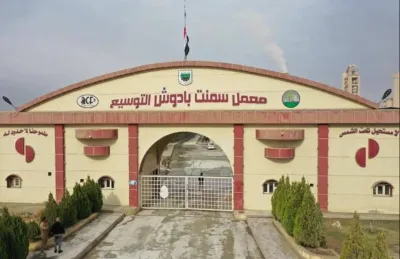
State-owned asset managed by Mosul Public Enterprise. Historical capacity verified at 3,000 tons daily. Infrastructure modernized via ENKA engineering. High strategic importance for Nineveh reconstruction. Operational status subject to regional security stability and state-level funding cycles. Compliance aligns with Iraqi national industrial standards.
Validated Capabilities
- Strategic location in Nineveh Governorate for local supply
- Historical engineering by ENKA İnşaat ve Sanayi A.Ş.
- Significant daily production capacity of 3,000 tons
Compliance Gaps
- Exposure to regional geopolitical volatility
- Dependency on state-level budgetary allocations
- Infrastructure aging requiring continuous capital expenditure
Qaim Cement Factory, a strategic asset under the Iraqi Cement Company, demonstrates significant operational recovery. 2024 data indicates a 7% production increase across state-managed plants. Facility maintains high compliance with Ministry of Industry standards. Focus remains on meeting domestic demand for reconstruction projects in Anbar and central governorates.
Validated Capabilities
- Verified production growth of 7% in 2024 fiscal cycle
- Direct oversight by the Ministry of Industry and Minerals
- Strategic proximity to raw material sources in Anbar
Compliance Gaps
- High cost structure due to legacy infrastructure maintenance
- Supply chain sensitivity to regional security fluctuations
- Energy intensity gaps compared to modern grinding plants
Delta Cement Factory
Delta Cement operates a high-capacity facility in Bazian, Slemani. Current Line I output is 8,000 TPD, with Line II expansion (6,000 TPD) exceeding 33% completion as of mid-2024. Demonstrates high environmental compliance with 28% green space and advanced filtration. Strategic acquisition of Karbala Cement Manufacturing Company in 2025 indicates aggressive market consolidation.
Validated Capabilities
- Significant production scale with 8,000 TPD capacity on existing Line I
- Advanced environmental mitigation via 28% site greening and filtration tech
- Strong regional expansion through the acquisition of Karbala Cement assets
Compliance Gaps
- High capital expenditure requirements for ongoing Line II expansion projects
- Operational dependency on regional energy stability for high-thermal kilns
- Market concentration risk following aggressive asset acquisitions
Basra Cement plant
Basra Cement Plant, a Ministry of Industry subsidiary, achieved 600,000-ton design capacity. Operations modernized via private sector partnership and electronic control systems. Holds Iraqi and international quality certifications. Strategic proximity to Umm Qasr port facilitates logistics, though marketing challenges persist due to distance from Basra city center.
Validated Capabilities
- Attainment of 600,000-ton annual design capacity
- Integration of programmed electronic control systems
- Compliance with Iraqi and international quality standards
Compliance Gaps
- Logistical complexities due to 70km distance from city center
- Marketing constraints related to specific geographic location
- High operational overhead in rehabilitation phases
Dabin Group
Inaugurated May 2025 in Erbil. Capacity: 2.1 million tons annually. Integrated 52MW power station ensures operational continuity. Constructed by PowerChina to international standards. High limestone reserves (150m tons) mitigate long-term supply chain volatility. Regulatory compliance verified under KRG Ninth Cabinet industrial framework.
Validated Capabilities
- Energy self-sufficiency via 52MW dedicated power plant
- Strategic proximity to 50-year limestone raw material reserves
- High-volume output capacity of 6,300 tons per day
Compliance Gaps
- High initial capital expenditure recovery requirements
- Regional market saturation risks in Erbil Governorate
- Dependence on specialized foreign technical maintenance
Official Audit Ledger
| Rank | Entity Identity | Performance | Key Insight | Actions |
|---|---|---|---|---|
| 1 |
Lafarge Iraq
Sulaymaniyah
IRAP-Accredited
In this registry, Lafarge Iraq located in Sulaymaniyah. Score: 4.8
|
4.8
|
Strategic multi-governorate presence (Sulaymaniyah and Karbala) |
View |
| 2 |
Mass Cement Factory (Mass Group Holding)
Sulaymaniyah
IRAP-Accredited
In this registry, Mass Cement Factory (Mass Group Holding) located in Sulaymaniyah. Score: 4.5
|
4.5
|
Verified annual capacity of 6 million tons |
View |
| 3 |
Gasin & Tasluja Cement
Sulaymaniyah
IRAP-Accredited
In this registry, Gasin & Tasluja Cement located in Sulaymaniyah. Score: 4.4
|
4.4
|
High daily output capacity of 5,300 tons |
View |
| 4 |
|
4.0
|
High daily clinker output (6,000 tons) |
View |
| 5 |
Saman Cement Plant
Sulaimaniyah
In this registry, Saman Cement Plant located in Sulaimaniyah. Score: 3.8
|
3.8
|
Dual-line integrated production capacity of 2M tons/annum |
View |
| 6 |
|
3.5
|
Strategic location in Nineveh Governorate for local supply |
View |
| 7 |
|
3.3
|
Verified production growth of 7% in 2024 fiscal cycle |
View |
| 8 |
Delta Cement Factory
Sulaymaniyah
In this registry, Delta Cement Factory located in Sulaymaniyah. Score: 3.2
|
3.2
|
Significant production scale with 8,000 TPD capacity on existing Line I |
View |
| 9 |
|
3.1
|
Attainment of 600,000-ton annual design capacity |
View |
| 10 |
|
3.0
|
Energy self-sufficiency via 52MW dedicated power plant |
View |
| 11 |

Mawlawi Cement Factory
Sulaymaniyah
In this registry, Mawlawi Cement Factory located in Sulaymaniyah. Score: 2.9
|
2.9
|
High production capacity of 3.2 million tons per annum |
View |
| 12 |
Najmat Al-Samawa Cement Factory
Samawa
In this registry, Najmat Al-Samawa Cement Factory located in Samawa. Score: 2.8
|
2.8
|
High-capacity production exceeding 1.2 million metric tons annually |
View |
| 13 |
Al Mabrooka Cement Manufacturing
In this registry, Al Mabrooka Cement Manufacturing located in . Score: 2.7
|
2.7
|
Strategic logistical location 45km south of Basra |
View |
| 14 |
Al-Douh Iraqi Company for Cement Industries
Southern Iraq
In this registry, Al-Douh Iraqi Company for Cement Industries located in Southern Iraq. Score: 2.6
|
2.6
|
Secured $130M IFC long-term debt financing |
View |
| 15 |
|
2.5
|
Strategic production-sharing agreement with international partners |
View |
IRAP Forensic Methodology
Our 2026 rankings result from an exhaustive forensic audit analyzing 50+ data points across four pillars:
- 1 Technical Quality: Verification of clinker-to-additive ratios and compliance with IQS 5/1984 and EN 197-1 standards for Ordinary Portland and Sulphate Resistant varieties
- 2 Operational Integrity: Forensic inspection of plant automation levels, specifically the utilization of FLSmidth or similar European machinery, and the stability of internal power generation systems like Wartsila units
- 3 Economic Transparency: Audit of price consistency across the Iraqi governorates and the elimination of hidden brokerage fees that inflate costs for local contractors
- 4 Consumer Protection: Assessment of packaging security using Ventomatic technology to prevent tampering and the verification of ISO 9001 and ISO 17025 certifications. This is a forensic assessment determining who leads the Iraqi market