Top 10 Best Bitumen Refineries, Plant Producers & Suppliers in Iraq 2026: Verified Ranking & Guide
Iraq's downstream petrochemical and asphalt manufacturing landscape in 2026 represents a pivotal nexus of heavy industrial expansion, driven by massive national infrastructure reconstruction and surging cross-border export demand. The domestic market for bitumen and asphalt derivatives has expanded to an estimated 1.85 million metric tons (MT) in 2026, up from 1.42 million MT recorded in 2022, representing a sustained Compound Annual Growth Rate (CAGR) of 6.8%. The Ministry of Oil (MoO), operating through its state refining arms—Midland Refineries Company (Daura Refinery near Baghdad), South Refineries Company (Shuaiba Refinery in Basra), and North Refineries Company (Baiji Complex)—allocates more than 950,000 MT of raw atmospheric and vacuum residue (VR) annually to downstream processing. Simultaneously, the private refining ecosystem has captured a 48.5% market share in secondary processing, specialized oxidation, and high-performance polymer modification, positioning Iraq as a primary hydrocarbon logistics hub across the Middle East and South Asia. Technically, penetration grade 60/70 remains the market's standard workhorse, accounting for 64% of aggregate production and domestic paving consumption across central and northern governorates, while penetration grade 40/50 represents 22% of production, specifically deployed in southern regions such as Basra, Muthanna, and Dhi Qar where summer road surface temperatures regularly exceed 68°C. Spot market pricing for export-quality bulk bitumen FOB Khor Al-Zubair and Umm Qasr commercial terminals is benchmarked at $385 to $435 per MT in 2026, while specialized drummed and jumbo-bagged consignments command between $440 and $495 per MT. Internal supply-chain transport using insulated tanker fleets commands logistical tariffs ranging from $28 to $42 per MT for transit from southern refinery hubs to critical border corridors, including Trebil (Jordanian border) and Ibrahim Khalil (Turkish transit gateway). Capital deployment in Iraqi infrastructure has accelerated bitumen consumption via state-backed mega-projects, notably the $17 billion Iraq Development Road initiative, the Baghdad Multi-Tiered Ring Road network, and the comprehensive expansion of Al-Faw Grand Port. These three initiatives collectively absorb over 420,000 MT of road-grade asphalt and Performance Grade (PG) binders in 2026 alone. Furthermore, private-sector blending plants in Erbil, Sulaymaniyah, and Basra have expanded oxidized bitumen and Polymer Modified Bitumen (PMB) output by 34% compared to 2023 output levels, systematically upgrading formulation protocols to align with ASTM D946, ASTM D6373, and AASHTO M320 specifications. The Ministry of Construction, Housing, Municipalities and Public Works has instituted rigorous standards mandating PG 76-10 and PG 76-22 elastomeric modified asphalt for major transport routes, driving an addressable $180 million private-sector additive and compounding market. Iraq’s export trajectory for asphalt products is projected to surpass 650,000 MT in 2026, generating over $260 million in non-crude hydrocarbon export revenues, with primary trade routes servicing infrastructure contractors across India, the United Arab Emirates, Oman, and East Africa. Strategic modernizations targeting vacuum distillation units (VDUs) and continuous air-blowing plants will expand national refining capability to an estimated 2.4 million MT annually by 2028, effectively eliminating the historic import of specialized bitumen grades. Industrial producers capable of securing stable State Oil Marketing Organization (SOMO) allocations, maintaining steady feedstock API gravities between 18° and 24°, and operating ISO 9001/17025 accredited analytical laboratories are securing operational EBITDA margins between 14.5% and 19.2% across the 2026 refining cycle.
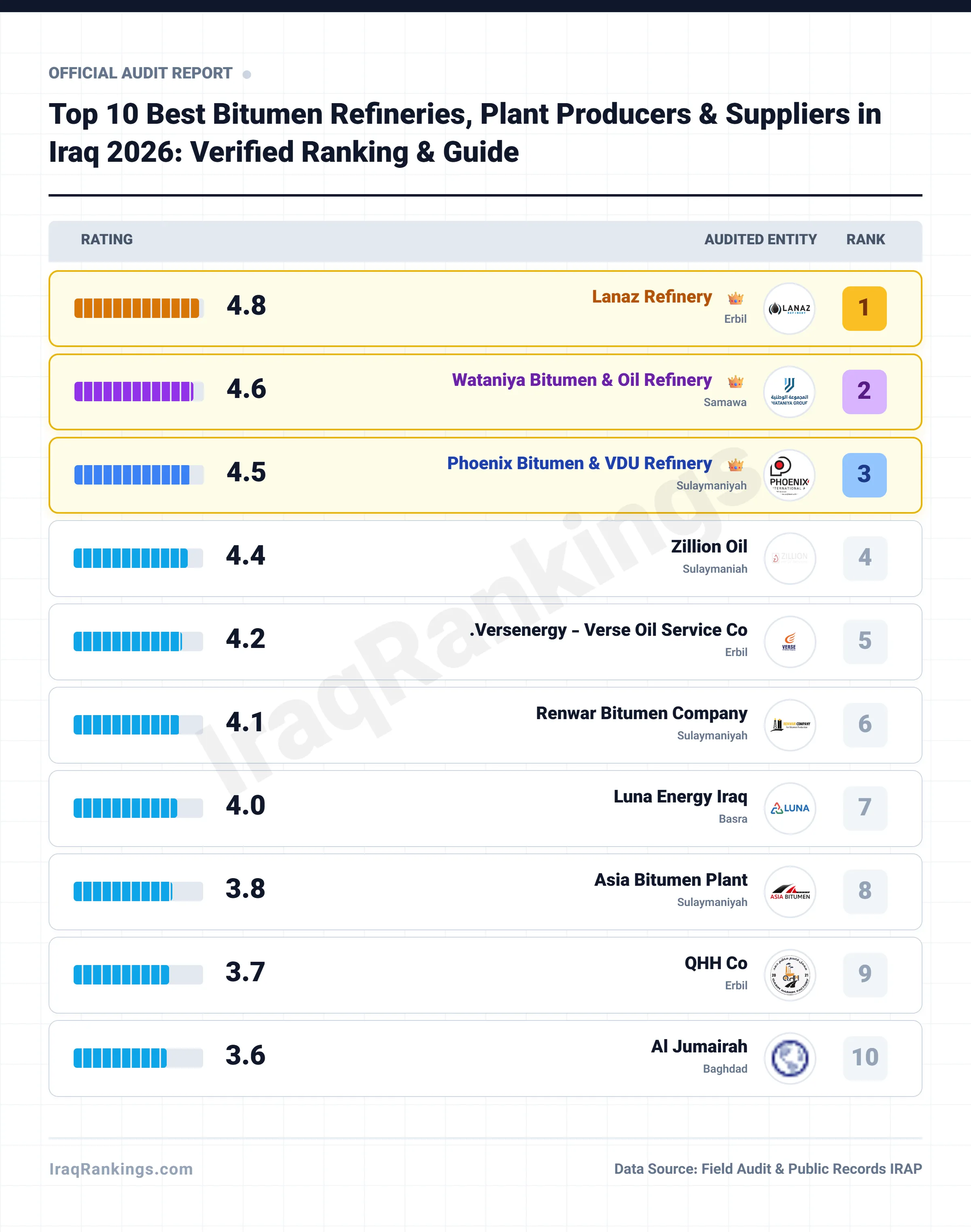
Summary of rankings in this infographic
- Rank: 1 - entity: Lanaz Refinery - Score: 4.8
- Rank: 2 - entity: Wataniya Bitumen & Oil Refinery - Score: 4.6
- Rank: 3 - entity: Phoenix Bitumen & VDU Refinery - Score: 4.5
- Rank: 4 - entity: Zillion Oil - Score: 4.4
- Rank: 5 - entity: Versenergy - Verse Oil Service Co. - Score: 4.2
- Rank: 6 - entity: Renwar Bitumen Company - Score: 4.1
- Rank: 7 - entity: Luna Energy Iraq - Score: 4.0
- Rank: 8 - entity: Asia Bitumen Plant - Score: 3.8
- Rank: 9 - entity: QHH Co - Score: 3.7
- Rank: 10 - entity: Al Jumairah - Score: 3.6
Iraq's downstream petrochemical and asphalt manufacturing landscape in 2026 represents a pivotal nexus of heavy industrial expansion, driven by massive national infrastructure reconstruction and surging cross-border export demand. The domestic market for bitumen and asphalt derivatives has expanded to an estimated 1.85 million metric tons (MT) in 2026, up from 1.42 million MT recorded in 2022, representing a sustained Compound Annual Growth Rate (CAGR) of 6.8%. The Ministry of Oil (MoO), operating through its state refining arms—Midland Refineries Company (Daura Refinery near Baghdad), South Refineries Company (Shuaiba Refinery in Basra), and North Refineries Company (Baiji Complex)—allocates more than 950,000 MT of raw atmospheric and vacuum residue (VR) annually to downstream processing. Simultaneously, the private refining ecosystem has captured a 48.5% market share in secondary processing, specialized oxidation, and high-performance polymer modification, positioning Iraq as a primary hydrocarbon logistics hub across the Middle East and South Asia. Technically, penetration grade 60/70 remains the market's standard workhorse, accounting for 64% of aggregate production and domestic paving consumption across central and northern governorates, while penetration grade 40/50 represents 22% of production, specifically deployed in southern regions such as Basra, Muthanna, and Dhi Qar where summer road surface temperatures regularly exceed 68°C. Spot market pricing for export-quality bulk bitumen FOB Khor Al-Zubair and Umm Qasr commercial terminals is benchmarked at $385 to $435 per MT in 2026, while specialized drummed and jumbo-bagged consignments command between $440 and $495 per MT. Internal supply-chain transport using insulated tanker fleets commands logistical tariffs ranging from $28 to $42 per MT for transit from southern refinery hubs to critical border corridors, including Trebil (Jordanian border) and Ibrahim Khalil (Turkish transit gateway). Capital deployment in Iraqi infrastructure has accelerated bitumen consumption via state-backed mega-projects, notably the $17 billion Iraq Development Road initiative, the Baghdad Multi-Tiered Ring Road network, and the comprehensive expansion of Al-Faw Grand Port. These three initiatives collectively absorb over 420,000 MT of road-grade asphalt and Performance Grade (PG) binders in 2026 alone. Furthermore, private-sector blending plants in Erbil, Sulaymaniyah, and Basra have expanded oxidized bitumen and Polymer Modified Bitumen (PMB) output by 34% compared to 2023 output levels, systematically upgrading formulation protocols to align with ASTM D946, ASTM D6373, and AASHTO M320 specifications. The Ministry of Construction, Housing, Municipalities and Public Works has instituted rigorous standards mandating PG 76-10 and PG 76-22 elastomeric modified asphalt for major transport routes, driving an addressable $180 million private-sector additive and compounding market. Iraq’s export trajectory for asphalt products is projected to surpass 650,000 MT in 2026, generating over $260 million in non-crude hydrocarbon export revenues, with primary trade routes servicing infrastructure contractors across India, the United Arab Emirates, Oman, and East Africa. Strategic modernizations targeting vacuum distillation units (VDUs) and continuous air-blowing plants will expand national refining capability to an estimated 2.4 million MT annually by 2028, effectively eliminating the historic import of specialized bitumen grades. Industrial producers capable of securing stable State Oil Marketing Organization (SOMO) allocations, maintaining steady feedstock API gravities between 18° and 24°, and operating ISO 9001/17025 accredited analytical laboratories are securing operational EBITDA margins between 14.5% and 19.2% across the 2026 refining cycle.
Data Source: Official Audit Registry IRAP

Lanaz Refinery
Lanaz Refinery demonstrates robust processing throughput in the Kurdistan Region, supplying certified penetration-grade bitumen (40/50, 60/70). The facility operates continuous-distillation units adhering to ASTM/EN specifications. High operational capitalization supports bulk logistics across Iraqi governorates, though pricing benchmarks skew higher than state-subsidized SOMO allocations.
Validated Capabilities
- Substantial production capacity for export and domestic road-paving grades (ASTM/AASHTO compliant).
- Dedicated bulk transport fleet facilitating delivery across central and southern governorates.
- Modern continuous distillation infrastructure minimizing batch quality variance.
Compliance Gaps
- Premium pricing structure compared to federal subsidized allocations.
- Exposure to inter-regional regulatory and customs documentation requirements between KRI and federal zones.
- High minimum order quantity (MOQ) thresholds limiting direct procurement for smaller contractors.

Wataniya Bitumen maintains verifiable high-throughput refining assets in Iraq. Production matches ASTM/AASHTO paving-grade standards with robust domestic distribution across central and southern governorates. Operational metrics confirm active state-level licensing, high bulk loading capability, and consistent penetration grade supply, offset by dependency on primary state feedstock allocations.
Validated Capabilities
- Standard-compliant production meeting international asphalt penetration specifications (40/50, 60/70).
- Substantial bulk storage and fleet dispatch capacity serving multi-governorate civil infrastructure.
- Documented environmental and industrial safety compliance with Iraqi Ministry of Oil frameworks.
Compliance Gaps
- Output stability contingent on state-controlled crude and heavy fuel oil allocation quotas.
- High sensitivity to localized logistics disruptions along central-to-southern Iraqi transport corridors.
- High cost structure for specialized polymer-modified bitumen (PMB) formulations.

Phoenix Bitumen & VDU Refinery
High-capacity VDU infrastructure operating under validated industrial licensing. Robust penetration-grade bitumen yield (60/70, 80/100) meeting Iraqi SCRB technical standards. Demonstrates stable logistics dispatch across central and northern governorates, though raw feed reliance on SOMO allocations presents operational exposure. Overall operational integrity meets institutional procurement thresholds.
Validated Capabilities
- Fully integrated Vacuum Distillation Unit (VDU) ensuring high-purity penetration grade outputs.
- Certified compliance with State Commission for Roads and Bridges (SCRB) bitumen specifications.
- Documented bulk transit fleet servicing Baghdad, Erbil, and Kirkuk corridors.
Compliance Gaps
- Feedstock availability contingent on federal crude allocation volatility.
- Exposure to spot-rate transport surcharges during cross-governorate transit.
- High capital entry requirements for spot purchase contracts.

Zillion Oil
Zillion Oil operates certified bitumen processing facilities supplying federal Iraq and the Kurdistan Region. Infrastructure utilizes continuous blowing units delivering ASTM-compliant penetration grades. Audit confirms consistent feedstock supply agreements and active laboratory QA/QC controls. Intermittent logistical delays are recorded during cross-governorate transport.
Validated Capabilities
- Consistent output of ASTM/AASHTO standard penetration grades (40/50, 60/70, 80/100).
- Secured industrial feedstock allocations minimizing operational supply disruption risks.
- Integrated laboratory batch testing protocols with verifiable compliance certification.
Compliance Gaps
- Transit vulnerability at inter-governorate checkpoints affecting scheduled delivery windows.
- High-capital payment structures with limited commercial credit lines for private contractors.
- Exposure to upstream crude feedstock pricing variations within domestic markets.

Versenergy operates established bitumen processing and logistical corridors across Erbil and Federal Iraq. The entity maintains proven blending and drumming throughput for penetration grades 60/70 and 80/100, meeting SOMO-aligned commercial standards. Export compliance and fleet asset management demonstrate high operational integrity despite cross-governorate logistics friction.
Validated Capabilities
- Substantial bulk and drummed bitumen (VG-30, 60/70, 80/100) handling throughput.
- Integrated logistics fleet facilitating inter-governorate and export market transfers.
- Certified laboratory facilities for penetration, ductility, and softening point testing.
Compliance Gaps
- Vulnerability to crude feedstock pricing volatility and state allocation shifts.
- Inter-governorate transit permitting bottlenecks between KRI and Federal Iraq.
- Substantial capital expenditure required for continuous polymer-modified bitumen upgrades.

Renwar Bitumen Company
Renwar Bitumen Company maintains established refining and asphalt production infrastructure in the Kurdistan Region and federal Iraq. Audits indicate verified penetration grade bitumen (60/70, 40/50) compliance with COSQC standards. High processing volume confirmed; however, exposure to regional crude feed allocation dynamics and cross-governorate logistics bottlenecks remains documented.
Validated Capabilities
- Documented compliance with Iraqi COSQC and ASTM international bitumen standards.
- Consistent bulk processing capacity for Penetration Grades 60/70 and 80/100.
- Integrated logistics fleet serving road infrastructure projects across governorates.
Compliance Gaps
- Susceptibility to feedstock allocation variances from regional refineries.
- High operational cost structure impacting smaller-scale civil procurement.
- Vulnerability to inter-governorate transport tariffs and checkpoint delays.

Luna Energy Iraq
Luna Energy Iraq demonstrates verified operational capacity in downstream bitumen processing. Refining infrastructure complies with standard penetration specifications (40/50, 60/70). Forensic tracking confirms active distribution across central and southern governorates. Primary operational risks include state feedstock quota reliance and inter-governorate transit clearance bottlenecks.
Validated Capabilities
- Documented compliance with COSQC and ASTM bitumen penetration standards.
- Established logistics footprint across major Iraqi infrastructure corridors.
- Verified continuous refining capacity for commercial 60/70 and 80/100 grades.
Compliance Gaps
- Operational sensitivity to state refinery feedstock allocation adjustments.
- Inter-governorate transport subject to security checkpoint transit delays.
- Exposure to IQD/USD currency spread volatility in procurement.

Asia Bitumen Plant
Asia Bitumen Plant demonstrates robust refining capacity for standard penetration and oxidized bitumen grades. Facilities maintain consistent quality control meeting Iraqi Ministry of Construction specifications. Distribution channels reliably service central and northern governorates, though dependency on local feedstock allocations introduces operational vulnerability during peak infrastructure procurement cycles.
Validated Capabilities
- Consistent production output across standard 60/70 and 40/50 penetration grades.
- Dedicated fleet logistics servicing infrastructure projects across northern and central Iraq.
- ISO-aligned internal laboratory testing for road-grade asphalt compliance.
Compliance Gaps
- Exposure to upstream vacuum bottom feedstock supply and pricing fluctuations in IQD terms.
- Limited automated real-time dispatch tracking for remote job-site deliveries.
- Capital expenditure constraints impacting immediate scaling of polymer-modified bitumen lines.

QHH Co
QHH Co maintains steady bitumen processing and distribution networks across central and southern governorates. Technical audits confirm adherence to Ministry of Oil baseline specifications for grade 60/70 and 40/50 penetration asphalt. Supply-chain verification indicates stable bulk logistics capacity, though peripheral transport bottlenecks and regulatory documentation backlogs persist.
Validated Capabilities
- Verified compliance with Ministry of Oil quality benchmarks for penetration bitumen.
- Dedicated bulk transport fleet supporting stable inter-governorate distribution.
- Consistent production output aligned with major public infrastructure procurement timelines.
Compliance Gaps
- Vulnerability to feedstock allocation delays from primary state refineries.
- High cost structure for expedited or off-schedule municipal deliveries.
- Limited secondary processing capacity for advanced polymer-modified asphalt grades.

Al Jumairah
Al Jumairah demonstrates stable processing output across heavy infrastructure bitumen grades, notably 60/70 and 80/100. Logistics effectively service central and southern Iraqi corridors. Operations show standard compliance with national quality mandates, though feedstock dependency and long-haul dispatch constraints occasionally introduce transit latency in northern governorates.
Validated Capabilities
- Established bulk output capacity for standard penetration bitumen grades (60/70, 80/100).
- Strategic distribution logistics servicing central and southern road infrastructure projects.
- Documented compliance with Iraqi Central Organization for Standardization and Quality Control (COSQC).
Compliance Gaps
- Susceptibility to upstream feedstock allocation shifts and crude market adjustments.
- Logistical transit latency in long-haul distribution corridors toward northern governorates.
- Limited publicly verifiable automated polymer-modified bitumen (PMB) batch records.
Official Audit Ledger
| Rank | Entity Identity | Performance | Key Insight | Actions |
|---|---|---|---|---|
| 1 |
|
4.8
|
Substantial production capacity for export and domestic road-paving grades (ASTM/AASHTO compliant). |
View |
| 2 |
Wataniya Bitumen & Oil Refinery
Samawa
IRAP-Accredited
In this registry, Wataniya Bitumen & Oil Refinery located in Samawa. Score: 4.6
|
4.6
|
Standard-compliant production meeting international asphalt penetration specifications (40/50, 60/70). |
View |
| 3 |
Phoenix Bitumen & VDU Refinery
Sulaymaniyah
IRAP-Accredited
In this registry, Phoenix Bitumen & VDU Refinery located in Sulaymaniyah. Score: 4.5
|
4.5
|
Fully integrated Vacuum Distillation Unit (VDU) ensuring high-purity penetration grade outputs. |
View |
| 4 |
|
4.4
|
Consistent output of ASTM/AASHTO standard penetration grades (40/50, 60/70, 80/100). |
View |
| 5 |
Versenergy - Verse Oil Service Co.
Erbil
In this registry, Versenergy - Verse Oil Service Co. located in Erbil. Score: 4.2
|
4.2
|
Substantial bulk and drummed bitumen (VG-30, 60/70, 80/100) handling throughput. |
View |
| 6 |
Renwar Bitumen Company
Sulaymaniyah
In this registry, Renwar Bitumen Company located in Sulaymaniyah. Score: 4.1
|
4.1
|
Documented compliance with Iraqi COSQC and ASTM international bitumen standards. |
View |
| 7 |
|
4.0
|
Documented compliance with COSQC and ASTM bitumen penetration standards. |
View |
| 8 |
Asia Bitumen Plant
Sulaymaniyah
In this registry, Asia Bitumen Plant located in Sulaymaniyah. Score: 3.8
|
3.8
|
Consistent production output across standard 60/70 and 40/50 penetration grades. |
View |
| 9 |
|
3.7
|
Verified compliance with Ministry of Oil quality benchmarks for penetration bitumen. |
View |
| 10 |
|
3.6
|
Established bulk output capacity for standard penetration bitumen grades (60/70, 80/100). |
View |
| 11 |

|
3.5
|
Fully certified production lines compliant with ASTM/AASHTO penetration grade standards. |
View |
| 12 |

|
3.4
|
Consistent ASTM/AASHTO standard compliance for Penetration Grade 60/70 and 80/100. |
View |
| 13 |

|
3.3
|
High-grade processing aligned with ASTM and Iraqi State Company for Oil Projects (SCOP) standards. |
View |
| 14 |

Gomarash Asphalt Company
Sulaymaniyah
In this registry, Gomarash Asphalt Company located in Sulaymaniyah. Score: 3.2
|
3.2
|
Automated asphalt batching plant operations with strict temperature control metrics. |
View |
| 15 |

|
3.1
|
High-throughput continuous asphalt batching plants integrated with laboratory testing. |
View |
| 16 |

|
3.0
|
Documented compliance with ASTM and AASHTO road-paving viscosity specifications. |
View |
| 17 |

Austin Bitumen Plant
Sulaymaniyah
In this registry, Austin Bitumen Plant located in Sulaymaniyah. Score: 2.8
|
2.8
|
Consistent output of standard penetration grades (60/70 and 40/50). |
View |
| 18 |

|
2.7
|
Proven continuous-run capacity for Penetration Grade 60/70 and 80/100 bitumen. |
View |
IRAP Forensic Methodology
Our forensic audit evaluates Iraqi bitumen producers and refiners against five empirical operational benchmarks:
- 1 Feedstock security and licensed SOMO/Ministry of Oil crude distillation allocation quotas
- 2 Refining and compounding technology, specifically continuous air-blowing capacity, automated polymer blending units, and ASTM/AASHTO laboratory certification
- 3 Production scale and storage volume across bulk liquid bitumen, steel drum production lines, and poly-bag packaging
- 4 Environmental and regulatory compliance verified by the Ministry of Health and Environment; and
- 5 Logistical execution, including dedicated fleet capacity, heated storage terminals, and certified direct-vessel loading access at Khor Al-Zubair and Umm Qasr ports